

The twin shaft mixer is a device that uses the synchronous rotation of a pair of spiral shafts with mixing blades to spray, humidify, and mix powdery materials while conveying them. A twin shaft mixer is designed to handle diverse materials, making the mixing equipment ideal for mixing and crushing clay materials in the ceramsite industry, as well as for uniformly mixing raw materials such as fly ash, aggregates, and additives. This twin shaft mixer features high mixing efficiency, compact structure, stable operation, and clean environmental performance. Twin shaft mixer is applied in chemical, mining, ceramsite and other industries for humidifying, mixing, and transporting solid particle materials or powders.
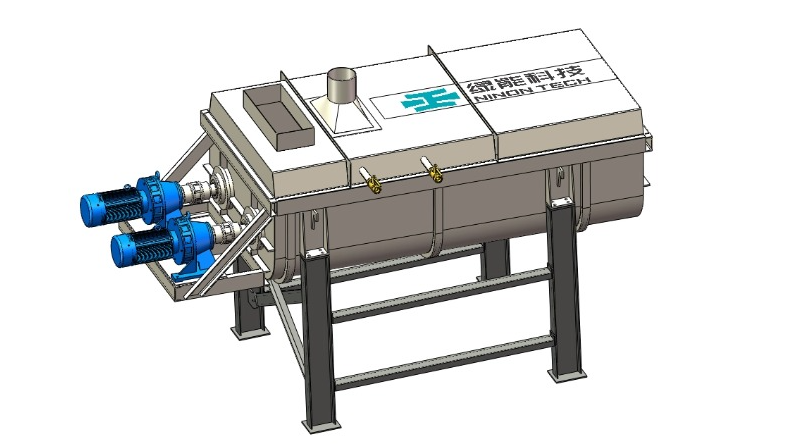
The prominent advantages of the continuous mixer are as follows:
1. The entire mixing and conveying process is carried out in a sealed space, with no dust leakage, ensuring clean and environmental-friendly operation. A continuous mixer maintains a closed workflow to avoid pollution, making the mixing equipment suitable for strict environmental standards.
2. The twin shaft mixer integrates mixing, humidification, and conveying functions, offering good mixing uniformity, high production efficiency, and large capacity. A continuous mixer streamlines processing steps to maximize output without compromising quality.
3. The shaft ends adopt a combined labyrinth and packing seal, providing double sealing effect with excellent sealing performance. This seal design in a continuous mixer prevents material leakage and extends equipment lifespan.
4. The mixing blades are made of wear-resistant materials and undergo special surface treatment, featuring high wear resistance. The durable blades of a continuous mixer ensure long-term reliability even with abrasive materials.
5. The whole mixing equipment has a compact structure, occupies small space, operates with stable transmission, high reliability, and low noise. A continuous mixer is engineered for space-saving installation and quiet, consistent performance.
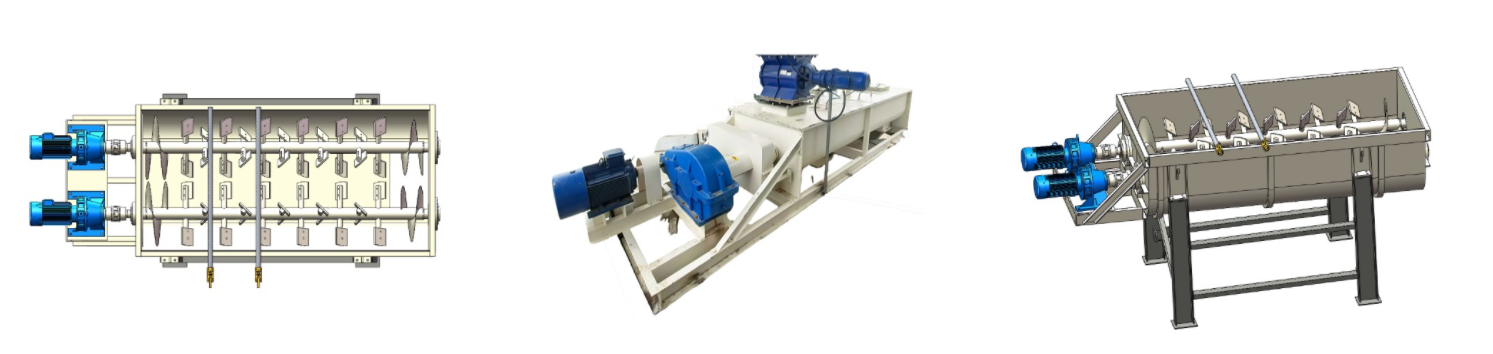
The main structure of the construction waste mixing equipment is shown in the figure below, mainly consisting of a driving device, feed inlet spiral shaft, trough body, discharge outlet, etc. The driving device of construction waste mixing equipment is composed of motor-coupling-reducer-gear pair. The motor drives the reducer through the coupling, which in turn drives the gear pair to realize the opposite movement of the two spiral shafts. Spiral blades made of wear-resistant materials are installed on the spiral shafts of construction waste mixing equipment. Materials enter the trough through the feed inlet, are mixed and crushed by the spiral blades, and are discharged from the discharge outlet after achieving uniform particle size.