

As a natural green building material, pebble features high hardness and corrosion resistance. It boasts abundant natural reserves and easy mining. Processed by professional sand making equipment including sand crusher and jaw crusher, pebble can be manufactured into high-quality sand that meets construction standards, thus being widely applied in construction, transportation infrastructure, water conservancy, hydropower and other industries that rely on aggregate shaping and sand making plant projects.
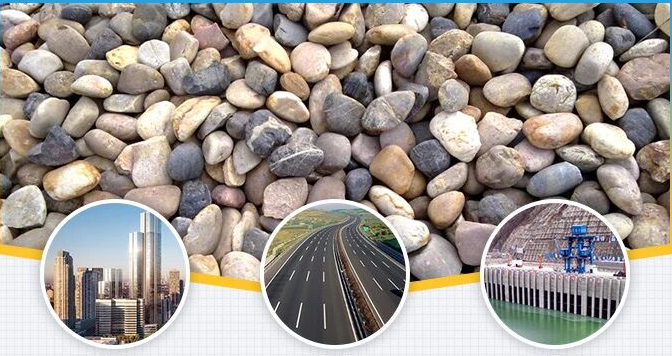
Pebble is characterized by high hardness and certain toughness. The most common types of sand making equipment on the market include jaw crusher, cone crusher, and sand crusher, which are core components of any efficient sand making plant and aggregate shaping and sand making plant.
Jaw Crusher
As the core primary crushing equipment in aggregate shaping and sand making plant, jaw crusher is essential when your raw material has a large particle size. It is necessary to first perform primary crushing with a jaw crusher, which lays a solid foundation for the subsequent work.
Jaw crusher features a wide crushing hardness range, with a crushing force of up to 320 MPa, and a maximum feed size of 1500 mm. Thanks to its large reduction ratio, this jaw crusher can reduce materials to medium size or below in a single pass, providing qualified raw materials for the sand crusher in the sand making plant.
The jaw crusher has a deep crushing chamber, simple structure, easy maintenance, compact size, light weight, and high output—all advantages that make it an irreplaceable part of sand making equipment. It is not prone to blockage when processing materials with high moisture content and high viscosity, which significantly reduces the operation cost of sand making plant, and also ensures the stable operation of the sand crusher.
Cone Crusher
The cone crusher, another important type of sand making equipment, is more suitable for secondary crushing in the sand making plant. Its feed size is slightly smaller than that of jaw crushers, generally below 600 mm, and the discharge fineness can be less than 60 mm. It is an ideal choice for secondary crushing in sand making plant, working closely with jaw crusher and sand crusher to improve product quality.
Cone crushers, as a vital part of sand making equipment, feature uniform discharge particle size. Adopting the principle of layered crushing, they enable selective material fragmentation, resulting in more even-shaped finished products with fewer flaky and elongated particles—perfect for meeting the requirements of aggregate shaping and sand making plant and supporting the sand crusher to produce high-standard sand.
Cone crushers also have fewer wearing parts, which is a great advantage for reducing the maintenance cost of sand making plant. Wear-resistant protection components can be installed on key parts, reducing downtime and maintenance frequency, improving the overall efficiency of the sand making equipment, and lowering the operating costs of the sand making plant and aggregate shaping and sand making plant.
Sand Crusher
For sand making applications inaggregate shaping and sand making plant, sand crusher is absolutely indispensable. As the core equipment for final sand forming, the most commonly used types of sand crusher in sand making equipment are vertical shaft impact (VSI) crushers and roller sand makers, which work with jaw crusher to complete the entire sand making process.
VSI sand crusher, a key type of sand making equipment, utilizes impact energy to crush materials based on the rock-on-rock principle. Materials pre-crushed by jaw crusher are accelerated by a rotor, and the high-speed materials collide with falling materials, resulting in the first crushing stage. Subsequent eddy current impacts enable secondary crushing, with discharge fineness controllable below 10 mm, meeting the core needs of sand making plant.
Roller sand crusher, another common sand making equipment, crushes materials using the pressure between a fixed roller and a movable roller, delivering a high pressure of 200 MPa. They are adaptable to both dry and wet materials, making them suitable for various aggregate shaping and sand making plant environments. The gap between the two rollers can be adjusted according to customer requirements to modify the discharge particle size, meeting diverse production needs of the sand making plant, and cooperating with jaw crusher to achieve flexible production.
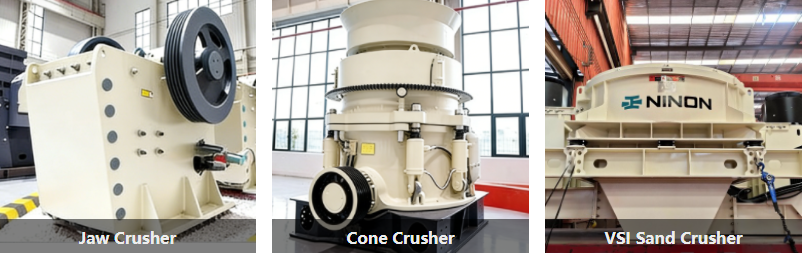
In actual production of aggregate shaping and sand making plant, the above three types of sand making equipment—jaw crusher, cone crusher, and sand crusher—are not used individually. Instead, they should be scientifically configured in line with raw material characteristics and finished product specifications to match your actual production requirements of the sand making plant, ensuring efficient, stable and cost-effective operation of the sand making equipments.