

Limestone is a commonly encountered soft rock and serves as the core raw material for many soft rock-based sand making plants. Today, we take limestone as a typical example to elaborate on the configuration of a high-efficiency aggregate production line, which is also applicable to an aggregate shaping and sand making plant. This process is a classic solution for most commercial aggregate processing systems currently, characterized by a streamlined flow and reduced demand for sand making equipment.
Before configuring a crushing and sand making plant, it is crucial to first clarify the properties of the raw material to be crushed, such as its feed size, hardness, moisture content, and other key indicators. In addition, clear requirements for output, finished product particle size and gradation must be defined, as these factors provide the necessary scientific basis for selecting suitable types of sand making equipment and configuring the manufactured sand production line. For example, using a hammer crusher for hard rock will lead to severe hammer wear and high spare parts replacement costs; on the contrary, adopting a cone crusher for soft rock in an aggregate production line will result in drawbacks like high initial equipment investment and high later maintenance costs.
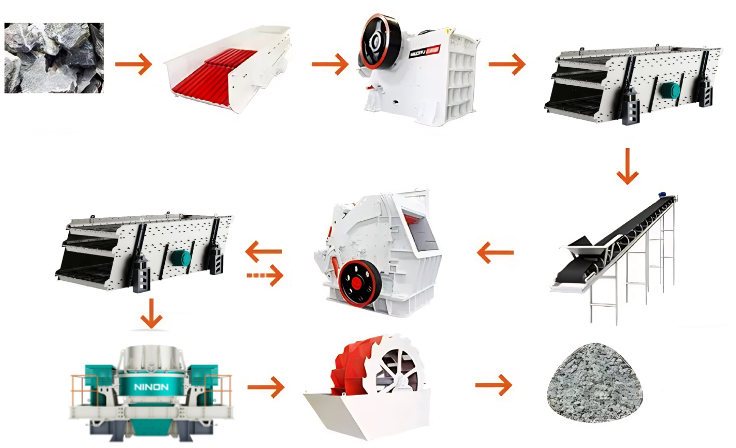
Sand making equipments for aggregate production line
Limestone Manufactured Sand Production Line Configuration
The workflow of a standard aggregate shaping and sand making plant generally includes feeding, crushing, screening and conveying. Raw limestone is transferred from the storage bin to a vibrating grizzly feeder, which then conveys it to the primary crushing equipment for coarse crushing. The coarsely crushed material is transported via a belt conveyor to the secondary crushing equipment for fine crushing, a key link in the aggregate production line.
After fine crushing, the material is conveyed by a belt conveyor to a circular vibrating screen for classification. Oversized material that exceeds the required size is returned to the secondary crusher for re-crushing to ensure product qualification. The material screened by the circular vibrating screen is the finished aggregate, which can be directly used or further processed in an aggregate shaping and sand making plant.
If a more refined particle shape is required, a vertical shaft impact (VSI) crusher—an essential piece of sand making equipment—can be added downstream for particle shaping. This improvement will optimize the manufactured sand production line, resulting in a more cubical and rounded final product with better quality, fully meeting the requirements of modern aggregate production.