

Winter concrete faces three core challenges: low temperature, slow hydration, and high frost heave risk. Mix design, as the foundation of quality control, directly determines workability, strength development, and long-term durability in cold environments, requiring strict compliance with GB50164-2011, GB50666-2011, and JGJ55-2011. Equally critical is equipment selection—Ninon planetary concrete mixer and countercurrent concrete mixer stand out as ideal solutions, addressing both material performance and mixing efficiency bottlenecks.
Raw Material Selection for Winter Concrete
Cementitious materials prioritize early-strength Portland cement (P·Ⅰ) or ordinary Portland cement (P·O42.5R、P·O52.5R), with Grade Ⅱ fly ash ≤20% and S95+ GGBFS ≤30%, and "dual blending" (20% GGBFS + 10% fly ash) recommended. Aggregates use granite/basalt crushed stone (crushing value ≤10%) and quartz medium sand (fineness modulus 2.3–3.0), with clay content ≤2.0%, clay lumps ≤0.5%, and water absorption <3%. Crushed stone adopts 5–25mm continuous gradation (void ratio ≤40%), sand ratio 40%–43%. Mixing water heats to 40–60℃ (≤80℃), and composite admixtures with water-reducing, early-strength, and frost-resistant functions are preferred.
Core Mix Parameters & Mixing Equipment Synergy
For C30 concrete, target strength is 41.2MPa (fcu,0=fcu,k+1.645σ+Δf), with key parameters: W/B=0.43, unit water≈165kg/m³, total cementitious materials=370kg/m³, admixture=2.0% (7.4kg/m³), and aggregates: fine aggregate≈800kg/m³, coarse aggregate≈1060kg/m³. Such precise ratios demand high-performance mixing equipment, and the planetary concrete mixer excels here. Its "revolution + rotation" design generates strong shearing force, ensuring uniform dispersion of low-dose insoluble powders—an issue plaguing ordinary mixers—via pre-mixing and precise feeding.
The countercurrent concrete mixer, on the other hand, is a powerhouse for large-volume winter construction. With doubled circumferential speed and 4x mixing intensity compared to conventional models, it cuts mixing time to 1/4, critical for maintaining concrete pouring temperature ≥5℃ in low temperatures. Both the planetary concrete mixer and countercurrent concrete mixer ensure high homogeneity, avoiding strength loss caused by uneven mixing.
Dynamic Adjustment & Emergency Support with Ninon Mixers
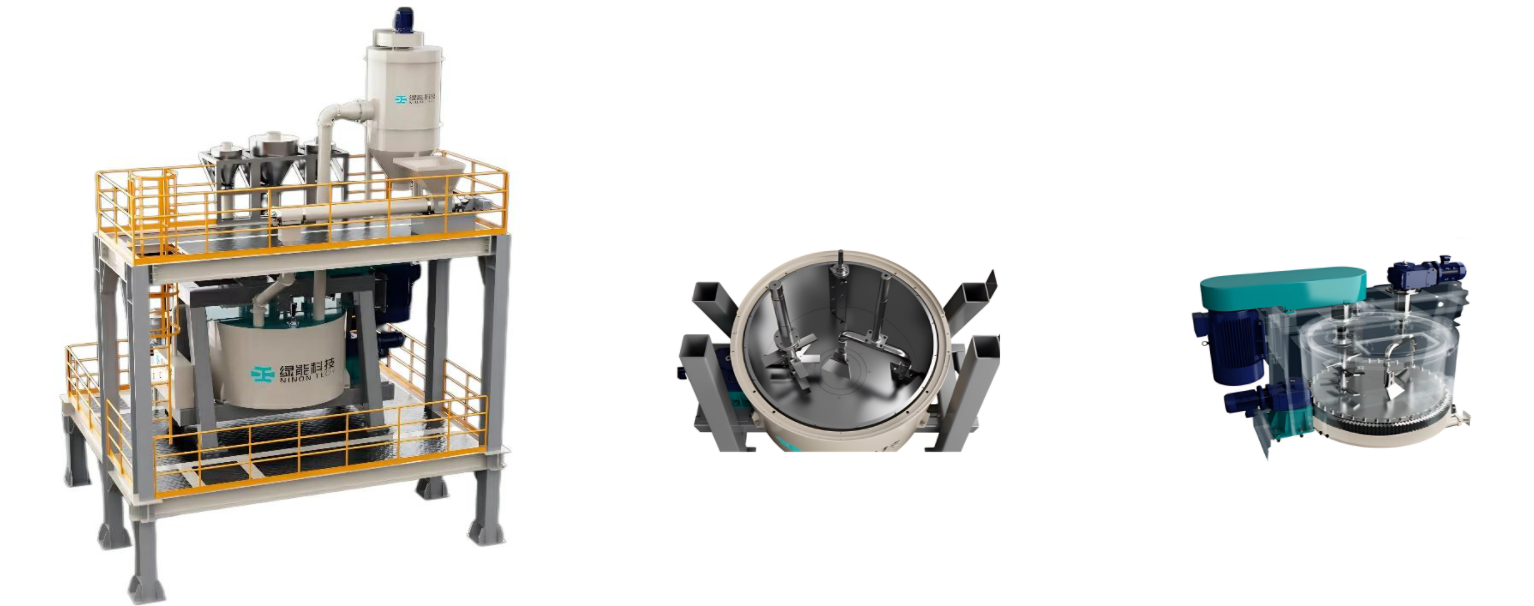
When temperature fluctuates >10℃, cement and admixture dosages adjust accordingly. The planetary concrete mixer's flexible control system adapts to raw material changes (e.g., cement strength drop) by optimizing mixing parameters. For sharp cooling emergencies, the countercurrent concrete mixer's high-efficiency output ensures rapid pouring, matching insulation measures to prevent frost heave. If 3d specimen strength is <18MPa, the planetary concrete mixer's consistent mixing quality lays a solid foundation for subsequent steam curing (40–50℃, RH≥90%).
Whether for high-precision precast components (planetary concrete mixer) or large-scale on-site construction (countercurrent concrete mixer), Ninon's equipment enhances production efficiency by 40% and reduces unit energy consumption by 18%. Their robust performance and adaptability make the planetary concrete mixer and countercurrent concrete mixer indispensable for winter concrete projects, ensuring quality and efficiency simultaneously.