

Screening equipment is primarily divided into two main categories: vibratory screens and static screens. Among these, vibratory screens are extensively utilized in aggregate production systems due to their superior performance. Static screens, which include grizzly screens and bar screens, are typically employed in coarse crushing plants or quarries of natural aggregate production systems to separate oversize stones.
Nevertheless, static screens have a low screening efficiency, merely ranging from 50% to 70%. Additionally, without vibration, materials are prone to blocking screen openings, making screen plate cleaning both time-consuming and laborious, which in turn hinders production. As a result, static screens are only used in situations where natural sand and gravel quarries have substantial reserves and a large number of oversize stones that must be entirely discarded.
Eccentric Vibratory Screen
Features: The eccentric shaft directly drives the screen box to perform a reciprocating motion in a vertical plane, with an amplitude twice the eccentricity. This type of vibratory screen boasts a sturdy structure, maintaining a constant amplitude regardless of changes in feed rate, along with strong and stable vibrating force that prevents screen clogging. However, the vibrating screen has a complex bearing structure and high inertia; due to incomplete dynamic balance during operation, it is likely to cause sympathetic vibration in the supporting structure.
Scope of Application: Eccentric vibrating scis suitable for screen apertures between 100 mm and 250 mm, often used in preliminary screening or as the first screening stage for sand and gravel aggregates. Currently, this type of vibratory screen is rarely used and has been mostly replaced by inertial vibratory screens.
Self-Centering Vibratory Screen(Single-Shaft Vibrating Screen)
Features: This screening equipment operates on the same principle as a pure inertial vibratory screen. Structurally, however, the pulley is concentric with the drive shaft, ensuring that the pulley center remains stationary during operation and the motor runs stably. The self-centering vibratory screen offers large amplitude and can generate relatively high exciting force, leading to high screening efficiency. It has a simple structure that is easy to manufacture, with no need for precise balancing of the exciter. Yet, when passing through the resonance zone during startup and shutdown, the amplitude becomes excessively large, which may damage the equipment itself and the supporting structure.
Scope of Application: Single-shaft vibrating screen is suitable for screening medium and fine aggregate particles under continuous and uniform feeding conditions, making it a practical choice of screening equipment for such scenarios.
Linear Vibrating Screen
Features: The linear vibrating screen is a specialized type of screening equipment where two eccentric shafts rotate synchronously in opposite directions, driving the screen to produce linear vibration. The linear vibrating screen surface is installed horizontally, featuring a large screening area and strong amplitude, which facilitates aggregate screening and ensures high hourly throughput. Despite its advantages, the linear vibrating screen has a complex structure, high cost, high energy consumption, and the linear vibrating screen is difficult to adjust in terms of amplitude.
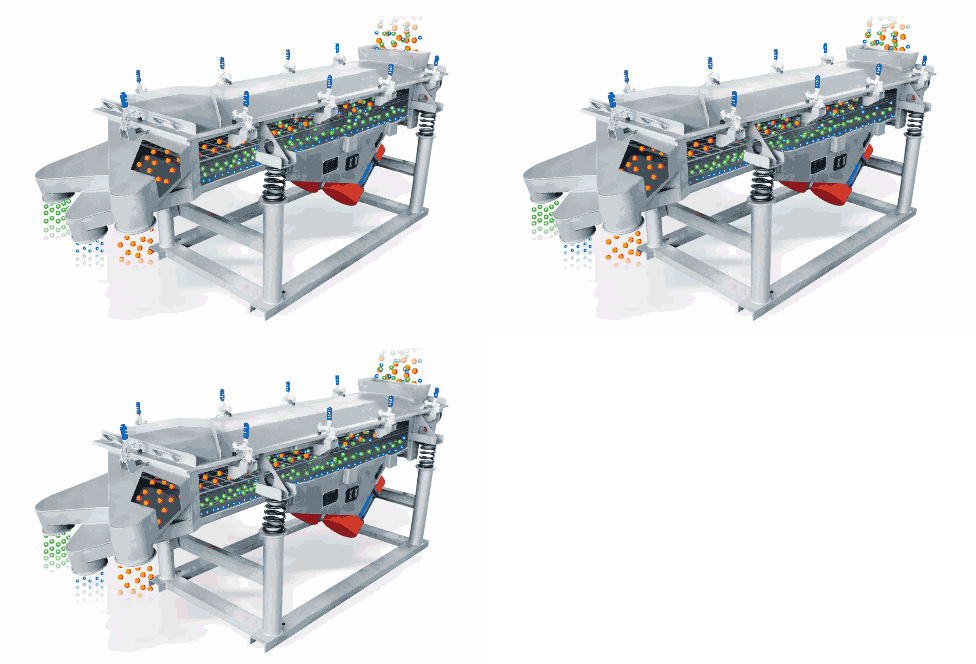
Linear Vibrating Screen
Scope of Application: As a versatile screening equipment, the linear vibrating screen is suitable for screening coarse, medium, and fine aggregates. Linear vibrating screen can also function as dewatering and desliming equipment in wet processing operations.
Constant Thickness Screen(Banana Screen)
Features: This type of screening equipment is designed such that material velocity gradually decreases along the fold-line screen surface with varying inclination angles, while the material bed thickness remains constant. It offers high hourly output, resistance to screen clogging, high production efficiency, and simple installation and operation. However, it requires a large installation space and has a complex screen deck structure compared to other vibratory screens.
Scope of Application: It is suitable for screening fine aggregates with a particle size not exceeding 25 mm, serving as an efficient screening equipment for such materials.
High-Frequency Vibrating Screen
Features: The high-frequency vibrating screen is a high-performance screening equipment characterized by high screening efficiency, small amplitude, and high vibration frequency. These features make high-frequency vibrating screen particularly effective for separating fine particles, distinguishing high-frequency vibrating screen from other types of vibratory screens.
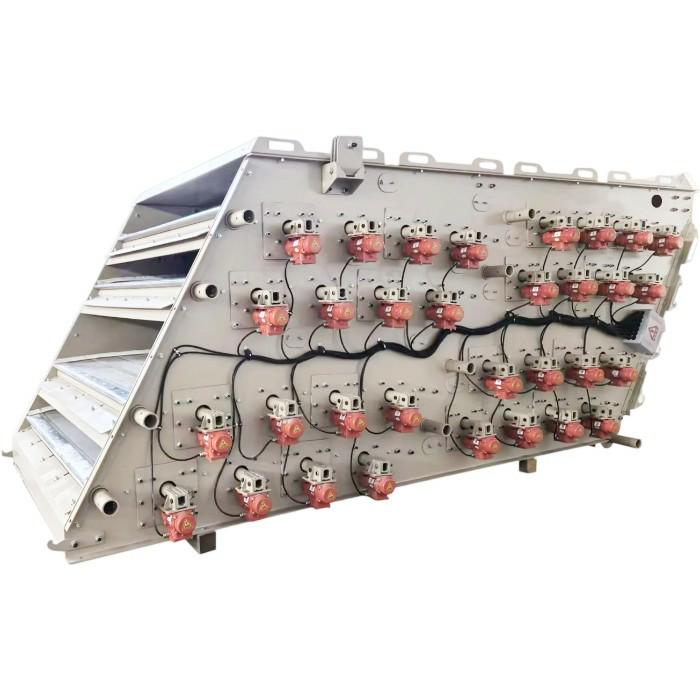
High-Frequency Vibrating Screen
Scope of Application: The high-frequency vibrating screen is suitable for screening materials with small particle sizes, where precision and efficiency are crucial.
Factorrs to Be Considered in Screening Equipment Selection
When selecting screening equipment, several key factors must be taken into account to ensure optimal performance.
1. The working area and capacity of the screening equipment should match the production requirements. the dimensions of the discharge chute connecting the aggregate conveying equipment and the vibratory screen must be properly matched with the dimensions of the screen deck to ensure uniform distribution of aggregates on the screen surface.
2. Dust collectors should be selected based on the amount of dust generated during screening to ensure that air pollution indicators at the production site comply with environmental protection requirements.
3. Attention should be paid to the wear resistance of the discharge chutes and hoppers of the vibratory screen, as well as the protection against noise pollution during material falling, to ensure long-term stable operation of the screening equipment.