

What is Masonry Mortar?
According to application scenarios, construction mortar can be classified into two categories: masonry mortar and rendering mortar.
Masonry mortar refers to the mortar used to bond bricks, stones, blocks, and other masonry units into an integral masonry structure. Its composition includes cement, other cementitious materials (e.g., lime putty, clay putty, etc.), fine aggregates, and water.
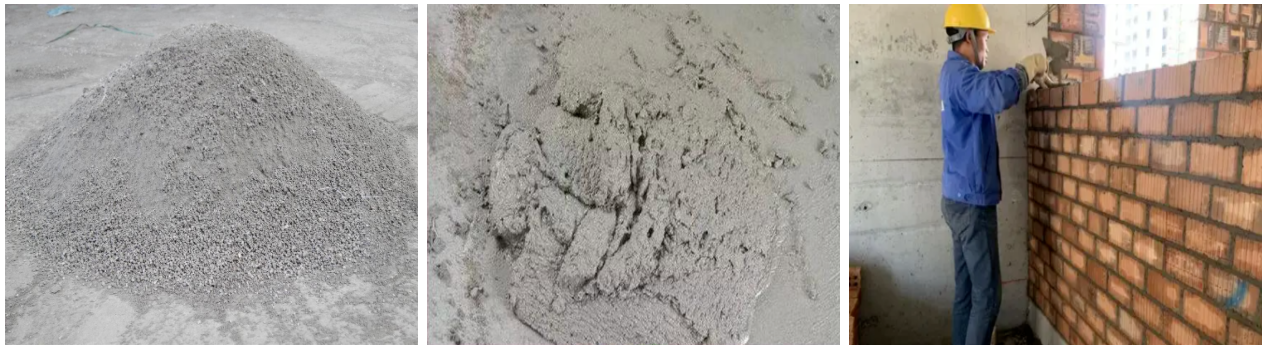
Key Points for Selecting Masonry Mortar
Cement types can be selected according to design requirements, masonry locations and ambient conditions. Medium and low-strength cement can meet the application needs. For cement mortar, the strength grade of cement should not exceed Grade 32.5; for cement-lime mortar, the strength grade of cement should not exceed Grade 42.5.
When quicklime is slaked into lime putty, it shall be filtered through a screen with a mesh size not larger than 3mm×3mm, and the slaking time shall be no less than 7 days; the slaking time of ground quicklime powder shall be no less than 2 days. Measures shall be taken to prevent drying, freezing and contamination of lime putty stored in sedimentation tanks. Dehydrated and hardened lime putty is strictly prohibited. The consistency of the lime putty used should be controlled at around 120mm.
Medium sand is preferred for preparing masonry mortar, while coarse sand is suitable for rubble masonry. The clay content of sand shall not exceed 5%; for cement-lime mortar with strength grade M2.5, the clay content of sand shall not exceed 10%. Clean water free from harmful impurities shall be used for mixing mortar.
Basic Requirements for Mix Proportion Design of Masonry Mortar
The mix proportion design of masonry mortar shall meet the following basic requirements:
(1) The workability of the mortar mixture shall satisfy construction requirements, and the bulk density of the mixture shall be not less than 1900 kg/m³ for cement mortar and not less than 1800 kg/m³ for cement-lime mortar.
(2) The strength and durability of the masonry mortar shall conform to the design requirements.
(3) It shall be economically reasonable, with minimized dosages of cement and admixtures.
Dry Mix Mortar Plant: The Core Tool Driving Efficient Production Upgrading
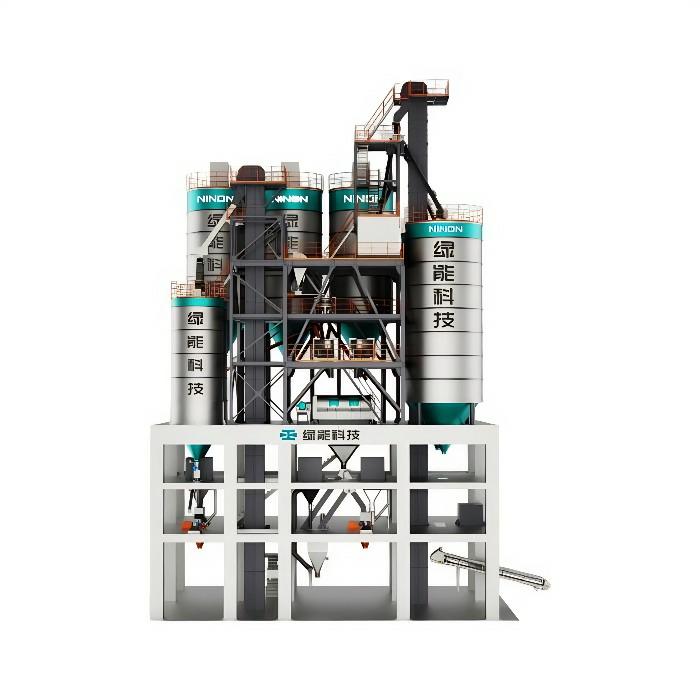
ready mix mortar plant
The Ninon dry mix mortar plant adopts a plowshare-type horizontal shaft mixer with high-speed blades. This ready mix mortar plant is integrated with intelligent weighing calibration and air pressure balance design, ensuring high metering accuracy for the dry mix mortar plant. The ready mix mortar plant can be connected to bagged material systems, storage tanks and bulk trucks simultaneously. Equipped with an efficient dust control system, the dry mix mortar plant meets stringent emission standards and green environmental protection requirements. The remote operation and maintenance intelligent control system of the ready mix mortar plant features a user-friendly interface that enables one-click start and stop.
The mortar mixer of the dry mix mortar plant boasts superior mixing precision, ensuring excellent workability and homogeneity of various materials without segregation during the mixing process, with a mixing ratio of up to 1:10000. This ready mix mortar plant also delivers high efficiency with short mixing cycles of 90–180 seconds (depending on different mortar products) and low mixing energy consumption. The dry mix mortar plant achieves high output with a maximum filling coefficient of 0.75%. The full-open discharge door of the ready mix mortar plant enables fast, residue-free and leak-proof discharging with a short discharging time.
Equipped with high-speed rotating blades made of wear-resistant alloy castings with excellent wear resistance, the dry mix mortar plant can rapidly mix colorants or fibers evenly, satisfying the mixing requirements of special mortars for the ready mix mortar plant.
Applications of Masonry Mortar in Engineering
◆ Cement mortar is suitable for masonry structures in damp environments and those requiring high strength; cement-lime mortar is applicable for masonry works in dry environments.
◆ Walls of multi-storey buildings generally adopt cement-lime mortar with a strength grade of M5.
◆ Brick columns, brick arches, reinforced brick lintels and other components usually use cement mortar with a strength grade ranging from M5 to M10.
◆ Brick foundations shall be constructed with cement mortar whose strength grade is not lower than M5.
◆ Lime mortar can be applied to low-rise buildings or bungalows; lime-clay mortar is suitable for simple temporary structures.