

What is Plastering Mortar?
Any mortar applied to the surface of buildings or building components is collectively referred to as rendering/plastering mortar.
Depending on their functions, rendering mortars can be classified into common rendering mortar, decorative mortar, and rendering mortar with certain special functions (e.g., waterproof mortar, thermal insulation mortar, sound-absorbing mortar, acid-resistant mortar, etc.).
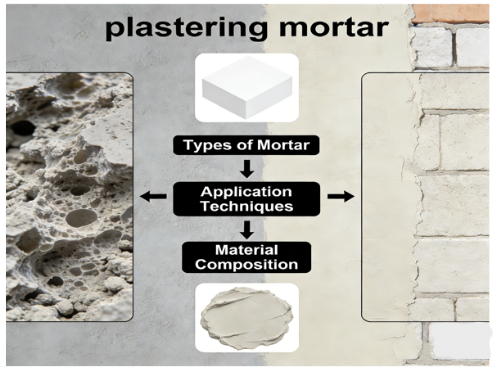
What are the Requirements for Rendering Mortar?
Rendering mortar is required to have good workability, allowing it to be easily applied as a uniform and smooth thin layer for convenient construction. It should also possess high bond strength, ensuring the mortar layer adheres firmly to the substrate and does not crack or peel off over time. For applications in damp environments or areas subject to external forces (e.g., floors, baseboards), it must additionally exhibit high water resistance and strength.
What are the Primary Functions of Common Rendering Mortar?
The primary functions of common rendering mortar are to protect walls and floors from erosion by wind, rain, and harmful impurities, thereby enhancing their moisture resistance, corrosion resistance, and weatherability, and increasing their durability. Simultaneously, it enables buildings to achieve a smooth, clean, and aesthetically pleasing surface finish.
Dry Mix Mortar Plant: The Core Tool Driving Efficient Production Upgrading
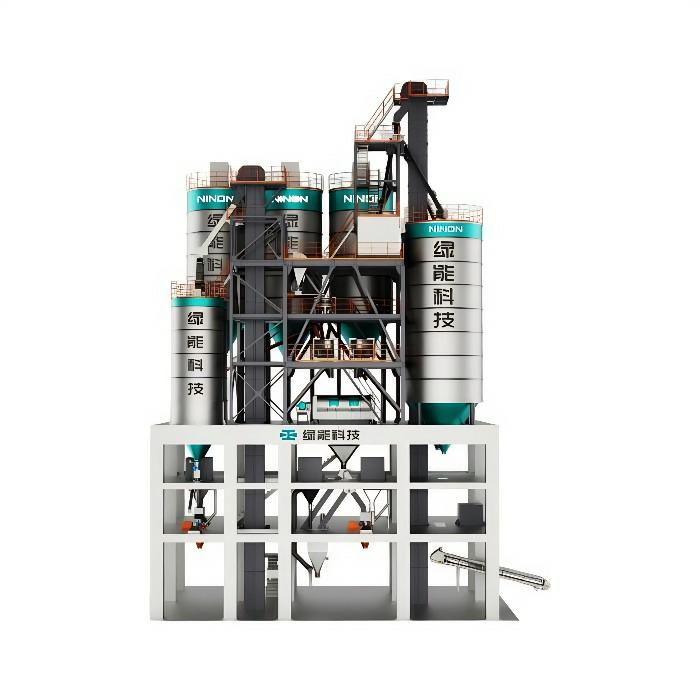
ready mix mortar plant
The Ninon dry mix mortar plant adopts a plowshare-type horizontal shaft mixer with high-speed blades. This ready mix mortar plant is integrated with intelligent weighing calibration and air pressure balance design, ensuring high metering accuracy for the dry mix mortar plant. The ready mix mortar plant can be connected to bagged material systems, storage tanks and bulk trucks simultaneously. Equipped with an efficient dust control system, the dry mix mortar plant meets stringent emission standards and green environmental protection requirements. The remote operation and maintenance intelligent control system of the ready mix mortar plant features a user-friendly interface that enables one-click start and stop.
The mortar mixer of the dry mix mortar plant boasts superior mixing precision, ensuring excellent workability and homogeneity of various materials without segregation during the mixing process, with a mixing ratio of up to 1:10000. This ready mix mortar plant also delivers high efficiency with short mixing cycles of 90–180 seconds (depending on different mortar products) and low mixing energy consumption. The dry mix mortar plant achieves high output with a maximum filling coefficient of 0.75%. The full-open discharge door of the ready mix mortar plant enables fast, residue-free and leak-proof discharging with a short discharging time.
Equipped with high-speed rotating blades made of wear-resistant alloy castings with excellent wear resistance, the dry mix mortar plant can rapidly mix colorants or fibers evenly, satisfying the mixing requirements of special mortars for the ready mix mortar plant.
Layers, Functions and Requirements of Application of Plastering Mortar
Common rendering mortar is typically applied in two or three layers. Since the requirements for each layer differ, the mortar selected for each layer also varies. Generally, the base coat mortar serves to bond with the substrate, requiring good workability and high bond strength. Therefore, the water retention of the base coat mortar must be excellent; otherwise, water can be easily absorbed by the substrate material, compromising the mortar's bond strength. A rougher substrate surface is beneficial for bonding with the mortar. The intermediate coat is primarily for leveling and may sometimes be omitted. The finish coat is mainly for achieving a smooth and aesthetically pleasing appearance, hence fine sand should be used.
How to Select Plastering Mortar?
For the base coat plastering of brick walls, lime mortar is commonly used. For the base coat plastering of lath walls or lath ceilings, mixed mortar or lime mortar is often used. For the base coat plastering of concrete walls, beams, columns, and slabs, mixed mortar, chopped straw lime mortar, or paper pulp lime mortar is typically employed.