

What is Compacted Solidified Soil ?
Rolled compacted solidified soil, also called compacted solidified soil, is a new material produced by adding curing agents to natural soil—mixed on-site directly or mixed thoroughly with a continuous mixer—followed by paving and compaction molding. It's widely used in subgrade filling, foundation treatment, and other engineering fields.
Its working principle: Curing agents (e.g., cement, lime, industrial by-product binders) are uniformly blended with undisturbed or local soil via a muck mixer or on-site mixing, triggering physical-chemical reactions like hydration, ion exchange, and pozzolanic reaction.
How to Construct Compacted Solidified Soil ?
There are two main construction methods for rolled compacted solidified soil: the road mixing method and the plant mixing method. The former involves spreading soil and curing agents uniformly in the filling area, then directly mixing and compacting on-site. The latter requires thoroughly blending soil materials and curing agents in a dedicated continuous mixer — the muck mixer guarantees homogeneous mixing—producing a uniform mixture that is then transported to the filling area for paving and compaction. The continuous mixer's efficiency shines in plant mixing, while the road mixing method leverages the muck mixer for flexible on-site operation.
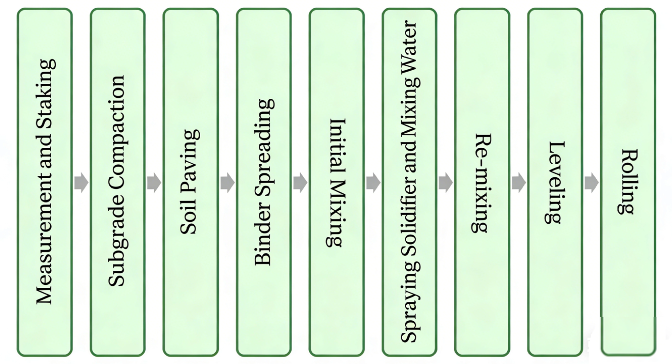
Process of road mixing method (on-site)
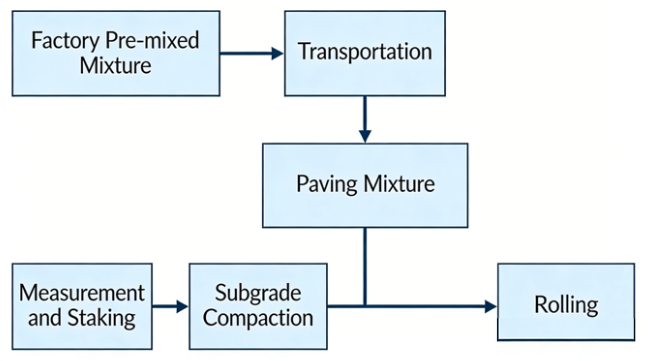
Process of plant mixing method (by continuous mixer/muck mixer)
The plant mixing method involves centrally mixing soil materials, curing agents, admixtures, and water at a designated mixing site using a continuous mixer. The homogeneous mixture produced by the muck mixer is then transported to the subgrade construction site for rolling compaction. The mixing quality of the continuous muck mixer is superior to that of the road mixing method, while the on-site surface leveling and rolling compaction procedures remain consistent. After each layer of solidified soil is compacted, it shall be cured for no less than 7 days, with surface roughening treatment. The subsequent construction phase can only start after the layer passes inspection and acceptance.
Advantages of Treated Compacted Solidified Soil
1. Local material utilization to cut costs: The simple construction process (mixing-paving-rolling) is highly mechanized, powered by a continuous mixer. The muck mixer enables efficient on-site operation, making it ideal for large-scale applications.
2. Significant strength and stability gains: A muck mixer ensures uniform blending of curing agents and soil, fostering full physical-chemical reactions to form cementitious products. Densifying soil structure, the compacted solidified soil treated by muck mixer offers higher bearing capacity, lower compressibility, and stronger shear strength than untreated soil.
3. Excellent durability and water stability: The muck mixer's thorough mixing optimizes solidification, enhancing water damage and freeze-thaw resistance—critical for moisture-sensitive colluvial residual/weathered soil. It adapts well to long-term road loads and environmental impacts.
4. Environmental friendliness and resource efficiency: Industrial wastes (fly ash, slag) act as curing agent components, fully integrated via the continuous mixer. This reduces waste stockpiling while boosting engineering sustainability, with the muck mixer ensuring consistent mixture quality.